 Featured: Chess
Sudoku Tips and Strategies: From Beginner to Expert
The best Sudoku tips are to scan before you write, find singles first, keep accurate pencil marks and learn a few patterns such as naked pairs, pointing pairs and the X Wing. Work through the techniques in a fixed order and you will never need to guess, even on hard puzzles.
This guide covers the rules in brief, then every key Sudoku strategy from beginner to expert, each with a checked diagram, plus a cheat sheet you can keep open while you play.
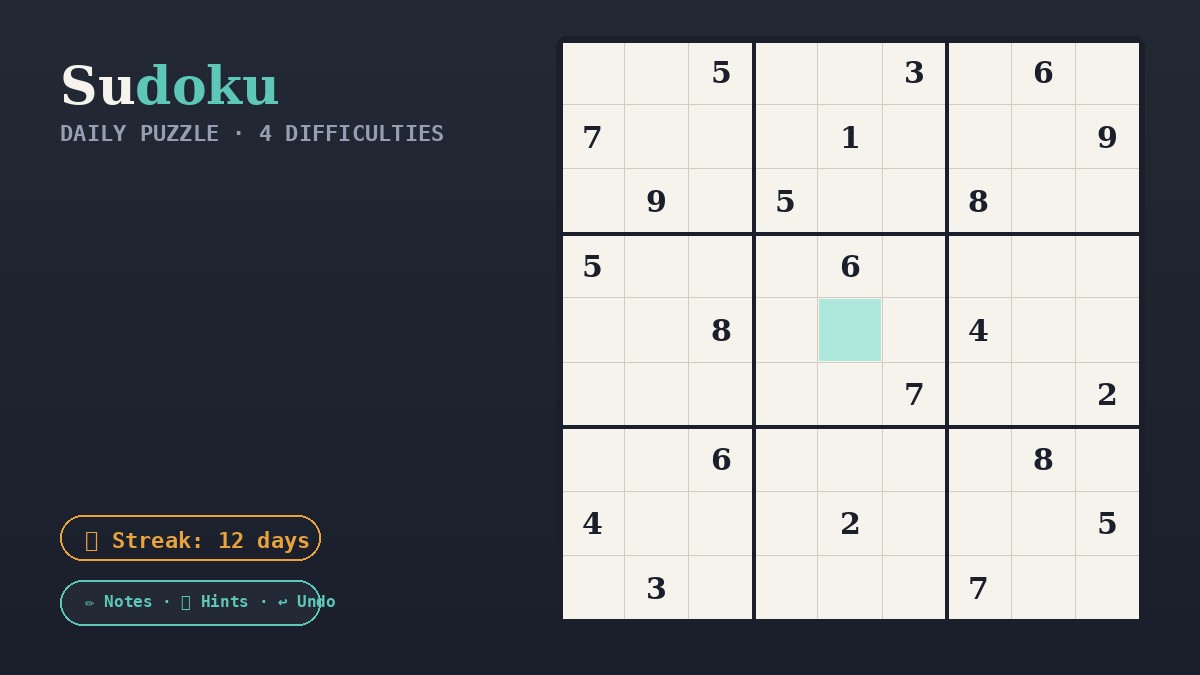 Play Sudoku freeA daily puzzle at four levels, notes, hints and undo, or race up to three friends live.Play now
Quick summary
- Rules: fill the 9x9 grid so every row, column and 3x3 box holds 1 to 9 exactly once.
- Start by scanning: cross hatch one digit at a time to find hidden singles, then count 1 to 9 for naked singles.
- Medium puzzles need naked pairs and pointing pairs. Hard puzzles add hidden pairs and the X Wing.
- Never guess. A valid Sudoku can always be solved with logic.
How to play Sudoku: the rules in 30 seconds
A Sudoku grid has 81 squares in nine rows, nine columns and nine 3x3 boxes. Some squares start with a number, called a clue or given. Fill every empty square with a digit from 1 to 9 so that no digit repeats in any row, column or box.
There is no math, the digits are just symbols. Every puzzle in our free online Sudoku is checked by a solver to have exactly one solution, so you never need to guess.
In this guide we name squares by row and column, so R1C3 means row 1, column 3. A unit is any row, column or box.
Tip 1: Scan before you write anything
Most of an easy puzzle falls to two simple scanning habits.
Cross hatching
Pick one digit and one box that is missing it. Trace the rows and columns where that digit already appears elsewhere. Each one rules out a whole line of squares in your box. If only one empty square survives, the digit goes there.
| 4 | 7 | 1 | ||||||
| 2 | 7 | |||||||
| 9 | 7 | |||||||
| 5 | ||||||||
| 6 | ||||||||
| 7 | ||||||||
| 2 | ||||||||
| 3 | ||||||||
| 8 |
When a digit has only one possible home in a unit like this, it is called a hidden single.
Counting 1 to 9
Now flip the question around. Pick a busy square and count which digits its row, column and box already contain. If eight different digits are already there, the ninth is the answer. That is a naked single.
| 4 | ||||||||
| 8 | ||||||||
| 1 | 2 | 7 | 3 | |||||
| 9 | ||||||||
| 5 | ||||||||
| 6 |
A scanning routine that works
- Start with the digit that appears most often in the grid. It blocks the most squares.
- Cross hatch that digit through every box that still needs it, then move to the next most common digit.
- Look at rows, columns and boxes that are almost full, and count what is missing.
- After each placement, recheck its row, column and box.
In our game, tapping a square lights up its row, column and box and highlights every matching number, which makes cross hatching much faster. The small number on each pad key also shows how many of that digit you still need to place.
Tip 2: Use pencil marks the right way
When scanning dries up, write candidates: the small digits that could still go in each square.
- Scan first, mark later. Place every single you can find before writing candidates. Fewer empty squares means fewer marks.
- Be complete. One missing candidate leads to wrong eliminations later.
- Keep marks tidy. Every time you place a digit, remove it from the candidates of every square in the same row, column and box.
On our site, turn on Notes (or press N) to write candidates. Erase clears a square and Undo steps back one move at a time.
Tip 3: Naked pairs, triples and hidden pairs
Naked pairs
If two squares in the same unit can only hold the same two digits, those two digits must go in those two squares in some order. That means no other square in that unit can hold either digit.
| 2 | 38 | 9 | 38 | 136 | 7 | 168 | 5 | 4 |
Naked triples
The same idea works with three squares that share three candidates between them, such as {1,4}, {4,7} and {1,7}. No square needs all three digits; together the three squares use only three digits, so those can be crossed off the rest of the unit.
Hidden pairs
A hidden pair is the mirror image. If two digits can only appear in the same two squares of a unit, those squares must hold those digits, even if their notes show other candidates too. You can delete every other candidate from those two squares. Find them by scanning digit by digit.
Tip 4: Pointing pairs and box line reduction
A pointing pair happens when, inside one box, a digit can only go in squares that share a single row (or column). The digit must end up in that row inside the box, so it cannot appear anywhere else in that row.
| 5 | 5 | 5 | 5 | 3 | 5 | |||
| 6 | 1 | 7 | ||||||
| 9 | 2 | 5 | 8 | |||||
| 5 | ||||||||
| 5 | ||||||||
| 5 | ||||||||
Box line reduction is the reverse. If, inside one row or column, a digit can only go in squares that all sit in the same box, then the digit cannot go anywhere else in that box.
Tip 5: The X Wing for hard Sudoku
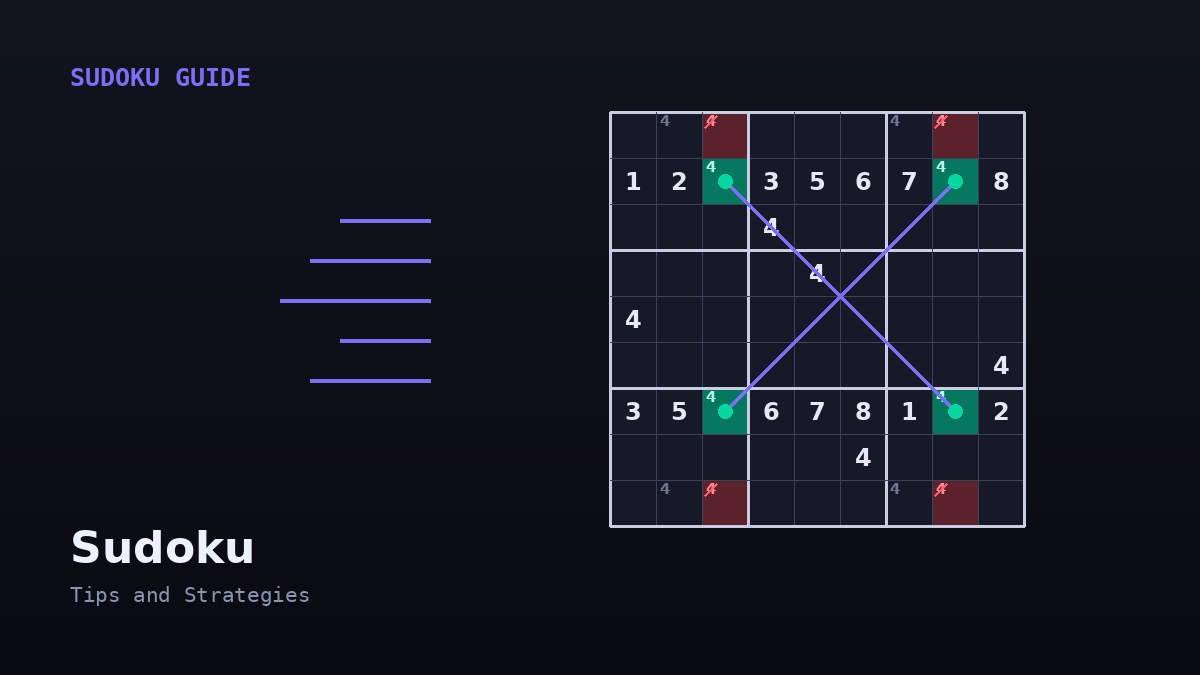
The X Wing is the first advanced technique most players learn. The pattern:
- Choose one digit.
- Find two rows where that digit has exactly two possible squares each.
- Check that those squares sit in the same two columns, forming a rectangle.
The digit must go in two opposite corners of that rectangle. Either way, each of the two columns gets its copy of the digit inside those two rows, so you can remove the digit from every other square in both columns. It also works with rows and columns swapped.
| 4 | 4 | 4 | 4 | |||||
| 1 | 2 | 4 | 3 | 5 | 6 | 7 | 4 | 8 |
| 4 | ||||||||
| 4 | ||||||||
| 4 | ||||||||
| 4 | ||||||||
| 3 | 5 | 4 | 6 | 7 | 8 | 1 | 4 | 2 |
| 4 | ||||||||
| 4 | 4 | 4 | 4 |
Here the X Wing removes 4 candidates at once, which often unlocks new singles.
For experts: Swordfish and XY Wing
A Swordfish is an X Wing with three rows and three columns: in three rows, a digit can only go in the same three columns, so it can be removed from the rest of those columns. An XY Wing uses three squares with two candidates each, like {A,B}, {B,C} and {A,C}. The {A,B} square is the pivot and sees both others. Whatever the pivot holds, one of the two wings must be C, so any square that sees both wings cannot be C. These appear in our Expert puzzles, alongside coloring chains.
What to do when you are stuck: a step order
When nothing jumps out, work through this list from the top and go back to step 1 as soon as you place a digit:
- Cross hatch every digit from 1 to 9 through every box.
- Check rows, columns and boxes with only two or three empty squares.
- Fill in or update your pencil marks and look for naked singles.
- Look for hidden singles digit by digit in each row and column, not just boxes.
- Look for naked pairs and triples, then hidden pairs.
- Look for pointing pairs and box line reduction.
- Look for an X Wing on each digit, then Swordfish and XY Wings.
That is how to solve hard Sudoku: the same basics, plus one or two advanced eliminations at the right moment.
Common mistakes to avoid
- Guessing. A guess that turns out wrong can spoil the whole grid. If you are not sure, write a note instead.
- Stale pencil marks. Forgetting to clear a candidate after placing a digit leads to false pairs and wrong eliminations.
How to get faster at Sudoku
- Play daily. Short, regular practice builds pattern recognition.
- Use the keyboard. On a computer, type 1 to 9, move with the arrow keys, press N for notes, Ctrl+Z to undo and Backspace to erase.
- Aim for zero mistakes first. Speed follows accuracy. Our game counts wrong numbers, so a clean solve is a good target.
How our Sudoku levels map to techniques
| Level | Clues | Techniques you need |
|---|---|---|
| Easy | 36 to 45 | Singles only |
| Medium | 30 to 35 | Pointing pairs, box line reduction, naked pairs |
| Hard | 26 to 31 | Adds hidden pairs, triples and sometimes an X Wing |
| Expert | 22 to 27 | Swordfish, XY Wings and coloring chains |
Each day there are four Daily Sudoku puzzles, one per level, and they are the same for everyone. New ones arrive at midnight UTC, and solving at least one each day grows your streak. In solo games you get three hints per puzzle, and wrong numbers turn red and add to your mistake count but never end the game. In Race friends, up to four players get the same puzzle, hints are off and the first correct grid wins.
Sudoku technique cheat sheet
| Technique | What to look for | What you do |
|---|---|---|
| Hidden single | A digit with only one possible square in a unit | Place it |
| Naked single | A square with only one possible digit | Place it |
| Naked pair or triple | 2 or 3 squares in a unit sharing only 2 or 3 digits | Remove those digits from the rest of the unit |
| Hidden pair | 2 digits that fit in only the same 2 squares of a unit | Remove all other candidates from those squares |
| Pointing pair | A digit confined to one row or column inside a box | Remove it from that row or column outside the box |
| Box line reduction | A digit in a row or column confined to one box | Remove it from the rest of that box |
| X Wing | A digit with two spots in each of two rows, in the same two columns | Remove it from the rest of those columns |
| Swordfish | The same pattern across three rows and three columns | Remove it from the rest of those columns |
| XY Wing | Pivot {A,B} seeing wings {B,C} and {A,C} | Remove C from squares that see both wings |
Like logic puzzles? Read our Mastermind strategy guide or learn to solve a cube with the Rubik's cube beginner guide, and try 2048, Arrow Slide or Number Hunt from our puzzle games.
Frequently asked questions
What is the best strategy for Sudoku?
Scan first and place every single you can find, using cross hatching for hidden singles and counting for naked singles. Then add pencil marks and look for pairs, pointing pairs and, on hard puzzles, the X Wing. Always go back to scanning after each new digit.
How do you solve hard Sudoku puzzles?
Keep complete, up to date pencil marks and work through the techniques in order: singles, naked and hidden pairs, pointing pairs, box line reduction, then X Wing, Swordfish and XY Wing. Hard puzzles usually need just one or two advanced steps, then fall to singles again.
What is an X Wing in Sudoku?
An X Wing happens when a digit has exactly two possible squares in each of two rows, and those squares line up in the same two columns. The digit must sit in opposite corners of that rectangle, so you can remove it from every other square in those two columns. It also works with rows and columns swapped.
What is a naked pair in Sudoku?
Two squares in the same row, column or box that can only hold the same two digits. Those digits must go in those two squares, so you can cross them off every other square in that unit.
Should you guess in Sudoku?
No. A proper Sudoku has exactly one solution and can always be solved by logic. Every puzzle on OnlineGames2Play is checked by a solver to have one solution, so if you feel stuck, look for the next technique instead of guessing.
Can I play Sudoku online with friends?
Yes. Choose Race friends on OnlineGames2Play and share the room code with up to three friends. Everyone gets the same puzzle and the first correct grid wins.
Looking for more? Browse all our puzzle games, read more guides on the OnlineGames2Play blog or head back to the free online games homepage.
Ready? Play Sudoku free nowA daily puzzle at four levels, notes, hints and undo, or race up to three friends live.Play now