 Featured: Chess
How to Play BS (Cheat): Rules, Strategy and How to Spot a Liar
BS is the card game where lying is not cheating, it is the entire point. You put cards face down, say what they are, and hope nobody calls you on it. Everyone is lying by the second lap. The skill is in choosing which lies to tell and, much harder, which ones to call.
This guide covers the full rules, the one rule almost everybody plays wrong, how to catch a liar using nothing but the cards in your own hand, and how to lie in a way that actually survives.
 Play BS free onlineBluff three computer opponents who count cards, or open a room for up to 6 friends. Free in your browser, no download.Play now
Quick summary
- Deal the whole deck out. Each turn has a required rank that climbs Ace, 2, 3 and upward.
- Put 1 to 4 cards face down and claim they are all that rank. You are allowed to lie, and often you have no choice.
- Anyone can call BS. The cards turn over. Wrong claim, the liar takes the pile. True claim, the challenger takes it.
- Empty your hand and survive the next challenge to win. Going out on a lie does not count.
What is the BS card game?
BS is a bluffing card game for two to six players, played with a standard deck and no equipment beyond it. Players take turns putting cards face down on a central pile while claiming a particular rank, and any other player may challenge the claim. It is one of the few card games where the cards matter less than whether people believe you.
If you grew up calling it something else, it is the same game. Cheat is the usual name in Britain, Ireland, Australia and New Zealand. BS is what most Americans call it. I Doubt It is the older and politer American name and the one in most printed card game books. Bluff and Liar turn up across Europe and South Asia. The rules are the same wherever you learned it; only the shouting differs.
BS card game rules
What you need
One standard 52 card deck and two or more players. Three or more is much better, and four is the sweet spot. With only two players a bluff has to get past a single person who is watching you closely, and the game turns into a grind.
How a turn works
- Deal the entire deck out, as evenly as it divides. Hands can differ by a card. There is no draw pile and nothing in reserve.
- Each turn has a required rank. The first is Aces, then twos, then threes, climbing to Kings and starting again. You do not choose it.
- On your turn, put 1 to 4 cards face down on the pile and say what they are. If the rank is sevens and you lay two cards, you are claiming two sevens.
- You must play. Passing is not an option, so when you hold none of the required rank you have no legal choice except to lie.
Calling BS
Once cards are down, any other player may call BS. The cards are turned face up and compared with the claim. There are exactly two outcomes, and they are symmetrical:
| The claim | What the cards were | Who picks up the pile |
|---|---|---|
| Two sevens | Two sevens | The challenger, for doubting an honest player |
| Two sevens | A seven and a four | The player who lied |
Whoever picks up takes the whole pile into their hand, which by mid game can be fifteen cards or more. That symmetry is what makes the call a real decision instead of a free shot. A challenge is not "do I think they are lying", because by the second lap everyone is. It is "is this particular lie worth the pile".
How to win
Empty your hand. That is the whole objective, with one condition in the next section that catches almost everybody the first time they play.
The one rule everyone gets wrong
Going out on a lie is not a win. A play is not final until the chance to challenge it has passed. If your last two cards go down as a false claim and somebody calls it, you pick up the entire pile and you are back in the game holding a fistful of cards.
Plenty of casual tables play it the other way, letting a player win the moment their hand is empty, and it ruins the endgame. It means the correct final move is always to dump whatever you have left and hope, which removes the only interesting decision at the end of the game. Played properly, you have to arrange your hand so that your last play can be honest, and that shapes how you discard from the very first turn.
How to spot a liar
Count, because counting is free
Only four of each rank exist. If you are holding three Queens and somebody claims two Queens, they cannot possibly be telling the truth, and calling costs you nothing because you already know the answer. This is the one piece of certainty the game hands you, it requires no reading of anybody's face, and most players never use it. Glance at your own hand before deciding whether to believe anyone.
Watch the size of the claim
A one card claim is nearly unreadable. A claim of three or four is usually a lie, for a simple reason: the more cards somebody claims of one rank, the more likely it is that somebody at the table holds enough of that rank to know it is impossible. Big claims are what desperate players make, and desperate players are the ones lying.
Watch who is nearly out
A player down to one or two cards is under the most pressure in the game. They must play every turn, they are unlikely to hold the required rank, and they need their final play to be honest. They are lying more often than anyone, and they are the most valuable person to catch, because sending them the pile undoes their entire game.
Remember who picked up
When somebody takes the pile you learn something concrete: they now hold every card that was just turned face up. If three sevens went into their hand two rounds ago and they later claim a seven, that claim is far more believable than it looks. This is the closest thing to card counting that BS allows, nobody at a casual table does it, and it is free information sitting in plain sight.
How to lie well
Lie small
One card at a time. A four card lie feels like progress and is how people end up holding twenty, because it is almost always caught. The arithmetic is against you: every extra card you claim raises the chance that somebody can prove you wrong without guessing.
Tell the whole truth when you can
An honest play can never be caught, ever. So if the rank is fives and you hold three fives, put down all three. Holding one back to keep your options open sounds clever and is a mistake, because you have slowed your own escape to keep a card whose rank will not come round again for another full lap of the table.
Keep pairs, throw singletons
This is the habit that separates players who win from players who merely survive. Because you can only go out honestly, the cards worth protecting are the ones that can leave together. Two of a kind is a way out of the game. Two unrelated single cards are not. When you are forced to lie, throw away the ranks you hold only one of and keep your pairs intact. Do that from the first turn and you arrive at the endgame holding something you can legitimately finish on, instead of one of everything and no way out.
Is BS luck or skill?
Both, and the balance shifts with the number of players. Two handed it is mostly luck: your opponent only has to see through one bluff at a time, and you cannot win without your final card happening to match the rank that comes next. Add players and the skill shows, because a bluff now has to survive three or four separate judgements and the quiet counter pulls ahead.
We built computer opponents for our online version and measured them against each other, which produced one genuinely counterintuitive result. Calling BS more often makes a player worse. An early version where the stronger opponent challenged more frequently lost to the weaker one, 38 games to 62, because every wrong call hands over the whole pile. Rebuilt so that the better player calls less often but more accurately, the same opponent went on to win about 85 games in 100. Restraint beats suspicion, which is advice that transfers straight to a human table.
Playing BS online
Our version runs in a browser with nothing to install. Play three computer opponents on easy, medium or hard, or open a room and send up to five friends a six letter code so everyone plays from their own phone. Nobody can see anyone else's cards, because your hand is only ever sent to your own device.
Two decks are available. The quick game uses 32 cards, Ace to 8, and runs about two minutes. The classic game uses all 52 and is considerably longer, which is the authentic experience if you want a proper session. Counting works identically in both, since either way there are only four of each rank.
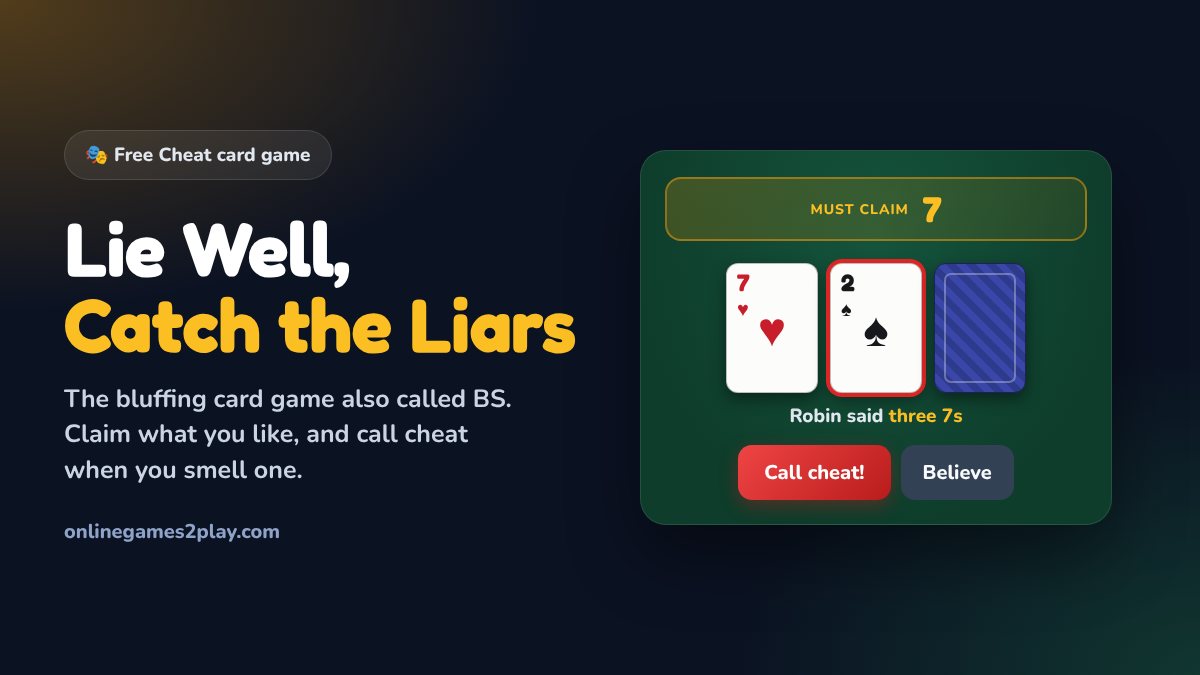
The interface does one thing worth mentioning here: the play button tells you when you are lying. Select cards that match your claim and it reads "Say 2 sevens" in gold. Select cards that do not and it changes to "Bluff: say 2 sevens" in red, before you commit. New players work out the whole mechanic from that one detail.
Frequently asked questions
What are the rules of the BS card game?
Deal the whole deck out between the players. Each turn has a required rank that climbs Ace, 2, 3 and upward. On your turn you place 1 to 4 cards face down and claim they are all that rank, truthfully or not. Any other player can call BS, which turns the cards over. If the claim was true the challenger takes the pile; if it was false the liar takes it. The first player to empty their hand and survive the next challenge wins.
Is BS the same game as Cheat?
Yes. BS, Cheat, Bluff, Liar and I Doubt It are all names for the same card game with the same rules. The name usually follows the country, with Cheat common in Britain and BS common in the United States.
How many players do you need for BS?
Two is the minimum but three or more is far better, because a bluff is much easier to get away with when several people have to decide independently whether to call it. Four is the ideal number. Six still works and makes for a faster game, since more cards leave play each round.
Can you win BS without ever lying?
Almost never. You must play on your turn, so whenever you hold none of the required rank you have no legal option except to lie. The skill is not avoiding lies, it is telling small ones at moments when nobody has a reason to doubt you.
How do you know if someone is lying in BS?
Count. Only four of each rank exist, so if you hold three Kings and somebody claims two Kings, they are certainly lying and calling costs you nothing. Beyond counting, claims of three or four cards are usually bluffs, and the player closest to running out is under the most pressure to lie.
What happens if you go out on a lie?
You do not win. A play only stands once the chance to challenge it has passed, so if your last cards are called and the claim was false, you take the whole pile and you are still in the game. Going out has to be done honestly, and that single rule is what gives the endgame its tension.
How many cards can you put down in BS?
One to four, because only four of each rank exist in a deck. Claiming four is legal and almost always a lie, which is exactly why it rarely survives.
Can I play BS online with friends?
Yes. One player creates a room and shares a six letter code or an invite link, and up to six people play together, each on their own device. It is free, needs no account and nobody ever receives anyone else's cards.
Looking for more? Try our Cheat card game, browse all our board and card games, read more guides on the OnlineGames2Play blog or head back to the free online games homepage.
Ready? Play BS free nowBluff three computer opponents who count cards, or open a room for up to 6 friends. Free in your browser, no download.Play now